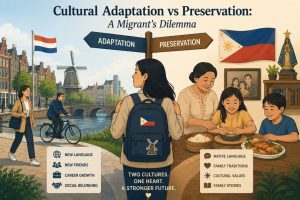
Migration is often described as a journey toward opportunity, but what happens when that journey quietly reshapes who you are? Rebuilding identity after migration is not just about adapting to a new country; it’s about rediscovering yourself in unfamiliar spaces. Many migrants find themselves caught between cultures, roles, and expectations, wondering: Where do I truly belong now?
This article explores how identity evolves after migration, and how you can consciously rebuild it with clarity, purpose, and resilience.
Why Identity Feels Lost After Migration
Cultural Displacement and Identity Shock
Moving to a new country often disrupts your sense of normalcy. Customs, language, humor, and even social cues shift dramatically. This creates what many call identity shock, a feeling of being disconnected from your former self.
In Chasing Windmills, Maya Butalid reflects on this duality, expressing how she felt shaped by both the Philippines and the Netherlands, yet fully belonging to neither in a simple way. This tension is common among migrants navigating multiple identities.
The Loss of Familiar Roles and Labels
Before migration, your identity may have been tied to your profession, social status, or family role. After moving abroad, these can dissolve overnight.
You may no longer be:
- The expert in your field
- The socially confident person
- The one who “knows how things work”
This loss can feel disorienting, but it also opens space for reinvention.
Language Barriers and Self-Expression
Language is deeply tied to identity. When you struggle to express yourself fully, it can feel like losing a part of who you are.
As described in Chasing Windmills, adapting to a new linguistic environment is not just practical; it reshapes how you think, relate, and present yourself to the world.
The Psychology of Rebuilding Identity After Migration
Identity Crisis vs Identity Transformation
What feels like a crisis is often the beginning of transformation. Instead of viewing identity loss as failure, it helps to reframe it as a process of growth.
Migration forces you to ask:
- Who am I without my past labels?
- What values truly define me?
The Rise of Hybrid Identity
Many migrants eventually develop a hybrid identity, a blend of their home culture and their adopted one.
Maya Butalid beautifully captures this when she writes about belonging to two places simultaneously. This “in-between” identity is not confusion, it’s expansion.
Emotional Phases of Identity Reconstruction
Most migrants go through similar emotional stages:
- Confusion
- Grief for the past self
- Exploration
- Integration
Recognizing these stages helps normalize the experience.
Signs You Are Successfully Rebuilding Identity After Migration
- You feel more comfortable navigating different cultures
- You define yourself beyond nationality or profession
- You embrace change instead of resisting it
- You feel a renewed sense of purpose
These are indicators that your identity is evolving, not disappearing.
How to Start Rebuilding Identity After Migration (Step-by-Step)
Step 1: Acknowledge the Identity Shift
Acceptance is the foundation. Denying the change only prolongs confusion.
Step 2: Reconnect With Your Core Values
Ask yourself:
- What beliefs have stayed constant?
- What truly matters to me, regardless of location?
Your values are your anchor.
Step 3: Redefine Your Personal Narrative
Instead of saying, “I lost who I was,” reframe it as:
“I am becoming someone new.”
In Chasing Windmills, the act of writing and reflection becomes a powerful tool for self-understanding, described as “a conversation with my soul.”
Step 4: Build New Cultural Anchors
Create routines that blend old and new:
- Cook food from home while exploring local cuisine
- Celebrate both traditional and new holidays
- Maintain meaningful rituals
Step 5: Find or Create Community Abroad
Identity is shaped through relationships. Seek out:
- Cultural groups
- Support networks
- Like-minded individuals
Connection reduces isolation and reinforces belonging.
Step 6: Experiment With New Roles and Interests
Migration gives you permission to reinvent yourself.
Try:
- New hobbies
- Different career paths
- Creative pursuits
Identity grows through experience.
Practical Exercises to Rediscover Yourself Abroad
Journaling Prompts
- “What parts of myself feel lost?”
- “What new parts of myself am I discovering?”
- “What does ‘home’ mean to me now?”
Identity Mapping Exercise
Draw three circles:
- Past Self
- Present Self
- Future Self
Identify overlaps and differences.
Cultural Integration Practice
Instead of choosing between cultures, combine them. This creates a more authentic and sustainable identity.
Challenges in Rebuilding Identity After Migration
Feeling Like You Don’t Belong Anywhere
This is one of the most common struggles. You may feel like an outsider both in your home country and your new one.
Pressure to Assimilate
There is often an expectation to fully adapt, but doing so at the cost of your authentic self can create internal conflict.
Loneliness and Isolation
Without familiar social networks, rebuilding identity can feel like a solitary journey.
How Migration Can Strengthen Your Identity
Increased Resilience
Adapting to a new environment builds emotional strength and flexibility.
Expanded Worldview
Exposure to different cultures broadens your understanding of life.
More Intentional Living
Migration forces you to consciously define who you are, something many people never do.
Real-Life Reflection: Identity as a Continuous Process
Identity is not presented as fixed, but as something continuously created and re-created. The journey from activism in the Philippines to integration into Dutch society illustrates how identity evolves through experience, reflection, and adaptation.
This reinforces a powerful truth:
You are not losing yourself – you are expanding who you are.
FAQs About Rebuilding Identity After Migration
How long does identity adjustment take?
It varies. For some, it takes months; for others, years. Identity rebuilding is not linear.
Is it normal to feel lost after moving abroad?
Yes. Feeling lost is a natural part of identity transformation after migration.
Can you have multiple identities?
Absolutely. A multicultural identity is not a weakness; it’s a strength.
You’re Not Starting Over – You’re Evolving
Rebuilding identity after migration is not about replacing your old self; it’s about integrating your past with your present. It’s a process of becoming more whole, more aware, and more intentional.
If you’re navigating this journey, know that your experience is valid and shared by many.
For a deeper, personal exploration of migration, identity, and transformation, you may find meaningful insights in this reflective work on The Heart of a Mother.
Migration changes more than your location; it reshapes your identity. But within that change lies an opportunity: to consciously rebuild who you are.
If this resonates with you:
- Reflect on your journey
- Share your experience in the comments
- Connect with others navigating similar paths
Because in the end, identity is not something you find, it’s something you create.