


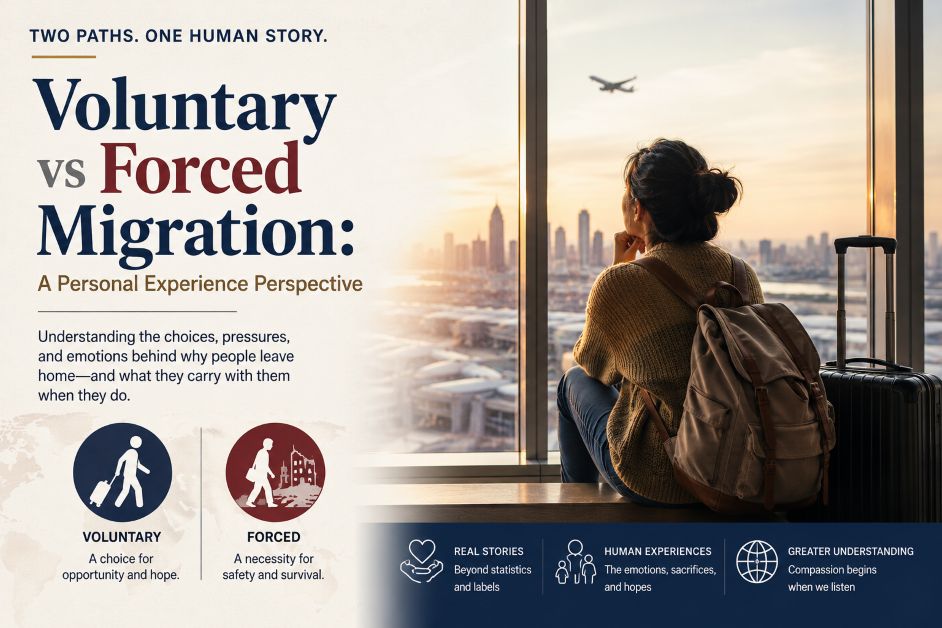
The distinction between voluntary vs forced migration becomes more complicated when we consider the person’s circumstances. A person may technically choose to leave while facing intense economic pressure, family responsibilities, political instability, or limited opportunities at home. Another person may be forced to leave suddenly but later make voluntary choices about where to live, work, and rebuild.
Migration is often described as either a choice or a necessity. Someone moves abroad for work, education, or family, and the move is called voluntary migration. Someone fleeing war, persecution, or immediate danger is described as experiencing forced migration. But real life is rarely that simple.
Understanding migration therefore requires more than categories. It requires attention to personal experience of migration, individual agency, family circumstances, emotional adjustment, and the conditions that shape a person’s choices.
What Is the Difference Between Voluntary and Forced Migration?
The basic difference concerns the degree of choice involved in a person’s migration decision.
Voluntary migration generally involves a meaningful degree of choice. People may migrate because of employment, education, family, lifestyle, or personal aspirations.
Forced migration occurs when people are compelled to leave because of circumstances such as conflict, persecution, violence, serious threats, or disasters.
However, the distinction is not always absolute. Choice versus constraint exists along a spectrum. A person may have the legal ability to remain but face circumstances that make staying extremely difficult.
What Is Voluntary Migration?
Voluntary migration occurs when individuals decide to move based on goals, opportunities, or personal circumstances.
Common forms include:
- Migration for work
- Migration for education
- Migration for family
- Career development
- Family reunification
- Better living conditions
- Personal aspirations
Someone may decide to move because a job offers better income. Another person may migrate to study. Parents may move because they believe another country can provide better educational opportunities for their children.
These decisions involve migration aspirations and personal agency, but that does not mean they are always easy.
What Is Forced Migration?
Forced migration involves displacement caused by circumstances that severely restrict or eliminate meaningful choice.
Examples include:
- War
- Persecution
- Violence
- Political instability
- Humanitarian crises
- Natural disasters
- Environmental displacement
People experiencing forced migration may become refugees, asylum seekers, or internally displaced persons, depending on their circumstances and legal status.
The important point is that forced migration involves a serious reduction in freedom of choice.
Why the Difference Is Not Always Black and White
The most useful way to understand migration is to recognize a forced-voluntary continuum.
At one end, a person may have considerable autonomy. At the other, someone may face immediate danger and have no realistic alternative.
Between these points are many forms of constrained migration, where a person has a decision to make but faces severe pressure.
Why Do People Migrate Voluntarily?
People migrate for many reasons, and these motivations can overlap.
Economic Opportunities and Employment
Economic migration is often associated with employment and financial security.
A person may move because wages are higher elsewhere, employment is unavailable at home, or professional opportunities are limited.
However, economic pressure can complicate the idea of choice. A worker may technically choose to migrate while feeling that remaining home would leave the family unable to meet basic needs.
This is why people migrate cannot always be answered with one simple explanation.
Education and Personal Aspirations
Education is another major reason for migration.
Students may move abroad to access universities, specialized training, or professional opportunities unavailable in their home communities.
For some, choosing to migrate represents an exciting opportunity. For others, the decision may involve financial sacrifices, family pressure and migration considerations.
Family and Relationships
Migration for family can involve marriage, reunification, caregiving, or children’s education.
A person may move to join relatives who already live abroad. Parents may migrate because they want better opportunities for their children. Adult children may relocate because they need to support parents or other relatives.
This demonstrates that migration decisions are often collective rather than purely individual.
Choosing a Different Future
Some people migrate because they imagine a different future.
They may want professional independence, greater social mobility, new experiences, or a different lifestyle.
Leaving home for a better life can therefore involve both ambition and sacrifice.
Why Are People Forced to Migrate?
Unlike many forms of voluntary movement, forced migration is driven by circumstances that make remaining unsafe or unsustainable.
War, Violence, and Persecution
Conflict can make ordinary life impossible. Families may leave because of violence, destruction, threats, or persecution.
For someone being forced to leave, the primary concern is often safety rather than opportunity.
Political and Social Pressure
Political instability, discrimination, persecution, and human-rights violations can also cause displacement.
A person may leave because expressing an opinion, practicing a belief, belonging to a particular group, or remaining in a particular community has become dangerous.
Environmental and Climate-Related Displacement
Flooding, disasters, environmental degradation, and the loss of livelihoods can also contribute to displacement.
In these situations, the line between environmental migration and forced displacement can become complicated because people may face several pressures simultaneously.
When Economic Hardship Becomes a Form of Pressure
Economic hardship deserves special attention.
A person may not be physically forced to leave, but severe poverty, unemployment, debt, or lack of opportunity may create limited alternatives.
This is one reason the category of reluctant migration is useful. It describes situations in which people have some agency but do not experience migration as a completely free choice.
Can Migration Be Both Voluntary and Forced?
Yes. A migration decision can contain both agency and constraint.
This is one of the most important ideas for understanding voluntary vs forced migration from a personal experience perspective, particularly when migration falls along a forced-voluntary continuum.
The Difference Between Choice and Real Alternatives
Having a choice between two options does not mean both options are equally acceptable.
Consider a parent who can remain in a community where employment is disappearing or move abroad to support the family financially.
The person chooses to migrate. Yet the decision may be heavily shaped by circumstances beyond personal control.
The important question is therefore not only:
“Did this person choose to leave?”
It is also:
“What realistic alternatives did this person have?”
Reluctant Migration: The Space Between Choice and Coercion
Reluctant migration occupies an important space between completely voluntary movement and direct coercion.
People may migrate because:
- Employment is unavailable.
- Family members depend on them.
- Safety has deteriorated.
- Education opportunities are limited.
- Economic conditions have become unsustainable.
- Social pressures make remaining difficult.
The person may have agency, but their decision is constrained.
Why “Voluntary” Does Not Always Mean “Free”
The word “voluntary” can create the impression that migration is easy.
It is not.
A person can voluntarily migrate while experiencing family separation, financial anxiety, uncertainty, and grief.
Voluntary migration describes the degree of choice behind movement. It does not describe how emotionally difficult the experience will be.
Voluntary vs Forced Migration Through a Personal Experience Perspective
Migration categories explain circumstances. Lived experience explains what those circumstances mean to an individual.
What Leaving Home Can Feel Like
Leaving home can produce several emotions at the same time.
A person may feel:
- Hope
- Excitement
- Fear
- Homesickness
- Guilt
- Relief
- Grief
- Uncertainty
These emotions can coexist.
Someone who moves abroad for an excellent job may still miss parents, siblings, friends, familiar food, language, and traditions.
The Emotional Cost of Voluntary Migration
The emotional impact of migration is sometimes overlooked because voluntary migrants are assumed to have chosen their circumstances.
But choosing to migrate does not remove emotional costs.
A person can be grateful for a new opportunity while grieving the loss of daily contact with family.
They can enjoy a new country while feeling isolated.
They can build a successful career while wondering whether they truly belong.
The Emotional Cost of Forced Migration
For people experiencing forced displacement, emotional consequences may be even more severe.
They may lose homes, communities, possessions, livelihoods, or contact with relatives.
The experience can involve fear, uncertainty, grief, trauma, and the difficult task of rebuilding a life.
Yet even forced migrants retain individual agency. Once they reach safety, they make decisions about work, relationships, education, community, and identity.
How Family Circumstances Shape Migration Decisions
Migration is frequently connected to family.
Migrating for Children
Parents may migrate because they believe another country can provide better education, healthcare, employment, or long-term opportunities for their children.
This can make family pressure and migration difficult to separate from personal ambition.
Supporting Parents and Relatives
Some migrants leave home to earn money and support relatives.
Remittances can become an important part of family life, but financial responsibility can also create emotional pressure.
When Family Love Becomes a Migration Pressure
Family relationships can encourage migration while also making it painful.
The Unconditional love of mothers in challenging times can illustrate how family bonds influence decisions, sacrifice, and resilience during periods of uncertainty.
Migration may therefore represent both separation and responsibility.
How Migration Changes Identity and the Meaning of Home
For many migrants, rebuilding a sense of home becomes part of adapting to life abroad.
Moving to another country can change how people understand themselves.
Identity After Migration
Migration and identity are closely connected.
A migrant may develop new cultural habits while maintaining traditions from home. Language, relationships, work, and social experiences can influence cultural identity over time.
Belonging Between Two Places
Some migrants develop a strong connection to both countries.
Others may feel that they belong completely to neither.
Finding belonging abroad can take time, especially when language barriers, discrimination, cultural differences, or social isolation affect everyday life.
Language, Memory, and Cultural Connection
Family stories can preserve memories, traditions, and cultural connections across generations.
Language and memory can maintain a connection to home.
Family traditions, stories, food, celebrations, music, and personal memories can preserve cultural identity even when someone lives thousands of miles away.
This is especially meaningful for Overseas Filipinos in the Netherlands and other diaspora communities whose identities may develop across multiple cultural settings.
A Simple Way to Understand Voluntary and Forced Migration
| Factor | Voluntary Migration | Forced Migration | Constrained or Reluctant Migration |
|---|---|---|---|
| Choice | Greater degree of choice | Little meaningful choice | Choice exists but is heavily pressured |
| Common drivers | Work, education, family | War, persecution, disaster | Economic hardship, insecurity, family responsibility |
| Preparation | Often more time | Often urgent | Varies |
| Emotional experience | Hope, uncertainty, homesickness | Fear, loss, uncertainty | Mixed emotions |
| Alternatives | Usually more available | Severely limited | Limited or undesirable |
| Example | Moving for employment | Fleeing conflict | Leaving because staying is no longer sustainable |
This comparison shows why migration decision-making cannot always be reduced to a simple voluntary or forced label.
Real-Life Examples Show Why Migration Categories Overlap
The Worker Who Leaves for Economic Opportunity
Imagine a worker who receives a job offer abroad.
The move appears voluntary. The worker chooses the destination and accepts the position.
However, the decision may also be influenced by unemployment, family debt, or responsibility for relatives.
The experience contains both opportunity and pressure.
The Family Forced to Leave Because of Conflict
A family may leave home because violence threatens their safety.
Their decision to leave is not voluntary in the ordinary sense.
They may later choose where to settle, how to work, and how to rebuild their community connections. Forced displacement does not eliminate agency forever.
The Parent Who Leaves Because Staying Is No Longer Sustainable
A parent may decide to migrate because employment opportunities at home cannot support the family.
No one physically forces the person onto a plane.
Yet economic conditions may make staying feel impossible.
This is a clear example of constrained choice.
What Migrants May Experience After Moving
The migration decision is only the beginning.
Homesickness and Family Separation
Homesickness after migration can affect people even when they are satisfied with their decision.
Distance changes family routines and removes everyday access to familiar communities.
Cultural Adjustment
Adjusting to a new country can involve learning language, customs, social expectations, and workplace norms.
Cultural adaptation may be exciting at times and exhausting at others.
Employment and Financial Pressure
Migration does not automatically create economic security.
Workers may experience unfamiliar employment systems, discrimination, financial obligations, or pressure to send money home.
Rebuilding a Sense of Belonging
Life after migration often involves rebuilding social networks.
Friendships, community organizations, cultural groups, workplaces, and family relationships can help migrants develop a new sense of belonging.
Why Personal Stories Matter in Understanding Migration
Personal stories of migration add human context to statistics.
Statistics Explain Patterns, but Stories Explain Experience
Migration data can show how many people move and where they go.
It cannot fully explain what leaving home feels like.
Personal stories of migration can reveal the emotional, family, and cultural dimensions that statistics cannot fully capture.
One Migrant Story Cannot Represent Everyone
There is an important caution.
One story should not replace evidence or become a stereotype in the opposite direction.
Personal experience of migration varies according to age, gender, family circumstances, economic resources, culture, legal status, and personal history.
Listening Without Reducing People to Labels
Better migration conversations allow migrants to describe their own motivations.
Instead of asking only whether someone is a “voluntary migrant” or “forced migrant,” we can ask what happened, what choices were available, what pressures existed, and how the person experienced the decision.
How to Talk About Voluntary and Forced Migration More Accurately
Avoid Treating Migration as a Simple Binary
The terms are useful, but they should not hide the forced-voluntary continuum.
Ask What Choices Were Actually Available
Consider the person’s economic, political, social, environmental, and family circumstances.
Consider the Person’s Experience Before the Label
Administrative categories can be necessary for policy and legal purposes, but lived experience can be more complicated.
Recognize Both Agency and Constraint
A migrant can demonstrate agency while facing substantial structural pressures.
Understanding both sides produces a more accurate account of migration.
Frequently Asked Questions About Voluntary vs Forced Migration
What is voluntary migration?
Voluntary migration occurs when a person moves with a meaningful degree of choice, often for employment, education, family, lifestyle, or personal aspirations.
What is forced migration?
Forced migration occurs when people must leave because of circumstances such as war, persecution, violence, disasters, or serious threats to safety.
What is the main difference between voluntary and forced migration?
The primary difference is the degree of meaningful choice. Voluntary migration generally involves greater agency, while forced migration involves severe constraints or circumstances that make remaining unsafe or impossible.
Can migration be both voluntary and forced?
Yes. Migration can exist along a continuum. A person may choose to leave while facing strong economic, family, political, or environmental pressures that limit realistic alternatives.
What are examples of voluntary migration?
Common examples include migration for work, education, family reunification, career development, and personal opportunities.
What are examples of forced migration?
Examples include displacement caused by war, persecution, violence, political repression, natural disasters, and serious humanitarian crises.
What is reluctant migration?
Reluctant migration describes movement where people have some ability to choose but face strong pressures that make staying difficult or undesirable.
Why does the distinction between voluntary and forced migration matter?
The distinction helps governments, researchers, and organizations understand migration patterns and protection needs. However, understanding the personal experience of migration also requires attention to individual circumstances and degrees of choice.
Conclusion: Migration Is More Than a Choice or a Circumstance
Voluntary vs forced migration is often presented as a simple contrast: one group chooses to move while another is forced to leave.
Real human experiences are more complicated.
A person may migrate for work while feeling pressure to support a family. Someone may leave for education while grieving the loss of daily contact with home. Another person may be forced from their community by conflict and later regain agency while rebuilding their life.
The distinction between voluntary and forced movement therefore becomes clearer when we examine choice and constraint, personal circumstances, family responsibilities, identity, and emotional experience together.
Migration is more than crossing a border. It can involve leaving home, rebuilding relationships, adapting to another culture, preserving identity, and finding belonging.
For many people, the decision to migrate contains both hope and sacrifice.
That is why listening to migrant experiences matters. The most accurate migration stories do not reduce people to categories. They recognize the circumstances that shaped their decisions while also respecting their agency, dignity, and individual voices.
If this perspective changed how you think about migration, share the article or leave a comment about how your own family or community understands the experience of choosing to migrate, being forced to leave, or living between two homes.


