


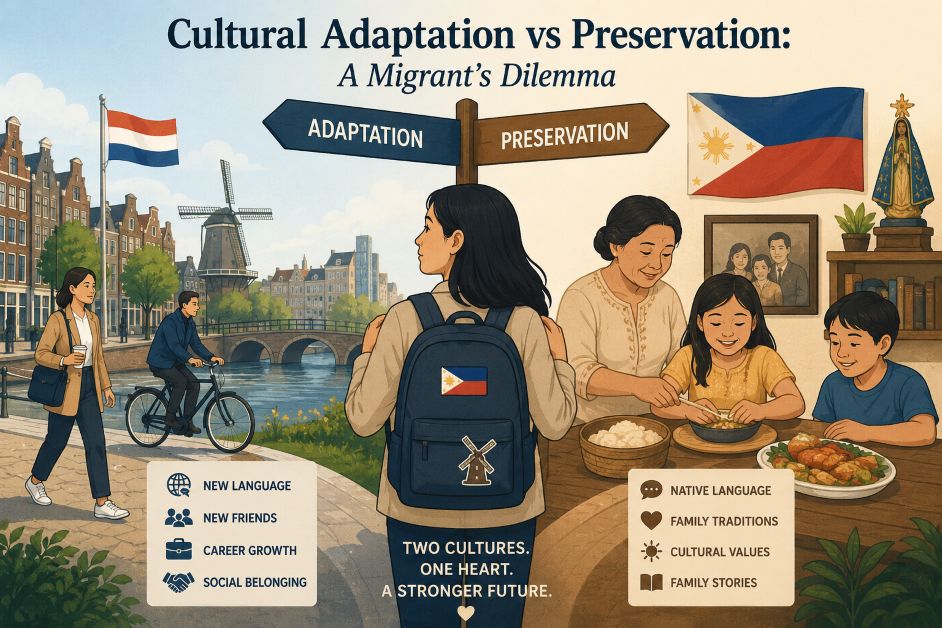
Migrating to another country changes more than a person’s address. It often changes daily habits, language, traditions, friendships, and even identity. Cultural Adaptation vs Preservation: A Migrant’s Dilemma is a challenge faced by millions of people who build a life far from the place they once called home. Every migrant must decide how much of their original culture to keep and how much to adopt from their new community.
For many migrant families, immigrants, and diaspora communities, this balance shapes their sense of belonging. It affects family relationships, cultural identity, language, traditions, and future generations. Many overseas Filipinos in the Netherlands know this experience well. They celebrate Filipino customs while embracing Dutch society, creating a life that reflects both cultures.
Some stories capture this journey with honesty and hope. Themes found in chasing windmills remind readers that migration is more than crossing borders. It is also about carrying memories, protecting family values, and finding strength through change. Whether someone leaves because of work, education, or the legacy of the underground movement in modern Philippines, the search for identity often continues long after arriving in a new country.
This article explores why cultural adaptation, cultural preservation, and the unconditional love of mothers in challenging times remain closely connected for migrants across generations.
Why Cultural Adaptation Matters
Cultural adaptation means learning how to function successfully in a new country. It includes understanding local customs, social expectations, language, and everyday behavior.
People adapt because they want to:
- Find employment
- Build friendships
- Communicate confidently
- Feel accepted
- Create stability for their families
Adapting does not always mean giving up one’s original identity. Instead, it helps migrants participate fully in their new society while maintaining meaningful parts of their heritage.
According to the International Organization for Migration (IOM), more than 280 million people worldwide live outside their country of birth. Every one of them faces some form of cultural adjustment.
Common Ways Migrants Adapt
Learning a New Language
Language opens doors.
It allows migrants to:
- Understand local laws
- Communicate at work
- Build friendships
- Help children succeed in school
Many Filipino migrants become fluent in Dutch, English, or other local languages while continuing to speak Filipino languages at home.
This bilingual ability often becomes one of the greatest strengths of migrant families.
Understanding Social Norms
Every country has different expectations.
Simple differences include:
- Greeting people
- Workplace etiquette
- Parenting styles
- School communication
- Holiday celebrations
Learning these customs reduces misunderstandings and helps migrants feel more comfortable.
Adaptation becomes easier through observation, patience, and community support.
Building New Relationships
Strong social connections improve emotional well-being.
Migrants often build friendships through:
- Community organizations
- Religious groups
- Volunteer work
- Schools
- Cultural events
These relationships reduce loneliness while helping newcomers understand their adopted country.
Why Cultural Preservation Is Equally Important
While adaptation helps migrants thrive, cultural preservation keeps identity alive.
Culture is more than traditional clothing or food.
It includes:
- Family stories
- Language
- Values
- Religious beliefs
- Music
- Celebrations
- Shared memories
When migrants preserve these traditions, they strengthen family bonds across generations.
Children learn where they came from, even if they were born in another country.
The Role of Family Traditions
Many traditions survive because families intentionally pass them forward.
Examples include:
- Cooking traditional meals
- Celebrating Filipino holidays
- Speaking native languages
- Sharing childhood memories
- Teaching respect for elders
- Practicing family customs
These activities create emotional connections that remain strong regardless of geography.
For many families, preserving traditions also honors parents and grandparents who sacrificed greatly to build better lives.
Language Connects Generations
Language carries history.
When children lose their heritage language, they may struggle to communicate with older relatives.
Simple conversations become difficult.
Family stories become harder to understand.
Many migrant parents encourage bilingual education because it strengthens both identity and communication.
Research consistently shows that bilingual children often gain cognitive, educational, and social advantages while remaining connected to their heritage.
The Emotional Cost of Losing Cultural Identity
Some migrants feel pressure to completely assimilate.
Over time, they may stop speaking their native language.
They may avoid traditional celebrations.
Some even hide parts of their identity to avoid discrimination.
While adaptation is valuable, abandoning one’s roots can create emotional conflict.
People may experience:
- Identity confusion
- Loneliness
- Isolation
- Guilt
- Loss of belonging
Children may also struggle to understand their family’s history.
Without cultural connections, later generations often feel disconnected from both countries.
The Migrant’s Daily Balancing Act
Few migrants live entirely within one culture.
Instead, they build lives between two worlds.
A person may:
- Speak Dutch at work.
- Cook Filipino meals at home.
- Celebrate Dutch national holidays.
- Observe Filipino family traditions.
- Raise bilingual children.
- Follow customs from both societies.
This balance is not a weakness.
It reflects resilience, flexibility, and love for both past and present.
Many successful migrant families find that embracing two cultures creates richer experiences rather than divided identities.
How Mothers Help Preserve Culture
Across many migrant families, mothers often become the strongest protectors of cultural identity.
Their influence appears in everyday moments.
They teach family recipes.
They tell childhood stories.
They celebrate important traditions.
They encourage respect for elders.
They pass along values through daily actions rather than formal lessons.
The unconditional love of mothers in challenging times often becomes the bridge connecting one generation to the next.
Even during financial hardship, political uncertainty, or migration, mothers frequently keep family history alive through conversation, care, and shared experiences.
Why Cultural Adaptation Matters
Every migrant must learn how to function in a new society. Cultural adaptation helps people communicate, work, study, and build relationships in their host country. It is more than learning a new language. It also means understanding local customs, respecting social expectations, and participating in community life.
For many overseas Filipinos in the Netherlands, adaptation happens through everyday experiences. Children attend Dutch schools, adults adjust to different workplace cultures, and families become familiar with local traditions and celebrations. These experiences help migrants feel accepted and confident in their new environment.
Successful adaptation offers many benefits:
- Better communication with local communities
- Greater employment opportunities
- Stronger social connections
- Increased confidence and independence
- A deeper understanding of the host country’s values
Adaptation should never be confused with abandoning one’s heritage. Instead, it creates opportunities while allowing migrants to remain true to who they are.
Why Cultural Preservation Is Equally Important
While adapting to a new country is valuable, cultural preservation provides stability and a sense of identity. Cultural preservation keeps traditions, language, history, and family values alive across generations.
Many migrant families continue to celebrate traditional holidays, prepare familiar meals, and speak their native language at home. These practices remind younger generations where they came from and strengthen family bonds.
Culture is preserved in many simple ways:
- Speaking Filipino with children and grandchildren
- Preparing traditional family recipes
- Celebrating Filipino holidays and festivals
- Sharing family photographs and stories
- Teaching respect for elders and family values
These traditions become even more meaningful after migration because they create a lasting connection to home.
The unconditional love of mothers in challenging times often plays a central role in preserving these customs. Mothers frequently become the bridge between generations, ensuring that family traditions continue even while living abroad.
The Emotional Challenge of Living Between Two Cultures
Many migrants describe feeling caught between two worlds. They appreciate the opportunities offered by their new country while missing the culture they left behind.
This emotional experience is common and does not mean someone has failed to adapt.
People may wonder:
- Am I becoming too different from my family back home?
- Will my children understand our heritage?
- Can I belong in two cultures at once?
These questions are part of the migrant experience.
Researchers studying migration often describe this as developing a bicultural identity. Instead of choosing one culture over another, migrants combine the strengths of both.
Someone may enjoy Dutch traditions while still celebrating Filipino family gatherings. They may speak Dutch at work and Filipino at home. This balance allows people to embrace change without losing their identity.
Family Stories Preserve More Than Memories
Every migrant family carries stories that deserve to be remembered.
Parents and grandparents often tell stories about childhood, difficult decisions, family sacrifices, and the journey to another country. These conversations become part of a family’s identity.
Some stories also preserve the legacy of the underground movement in modern Philippines, helping younger generations understand how political events shaped migration and family history.
These personal experiences provide something history books cannot always capture.
They explain:
- Why families left their homeland
- What challenges they faced
- How communities supported one another
- What values remained unchanged
Books like Chasing Windmills demonstrate how memoirs preserve lived experiences that might otherwise be forgotten. Personal stories help future generations understand that migration is not simply about moving to another country—it is about carrying identity, memory, resilience, and hope across borders.
Finding Balance Creates Lasting Belonging
The debate is often presented as choosing between adaptation and preservation. In reality, the healthiest path combines both.
Migrants do not have to abandon one culture to appreciate another.
Learning a new language does not erase one’s native language.
Celebrating local traditions does not replace family customs.
Instead, each experience adds another layer to personal identity.
For many overseas Filipinos in the Netherlands, this balance becomes a lifelong journey. They build successful careers, contribute to their communities, and embrace Dutch society while continuing to value Filipino hospitality, close family relationships, respect for elders, and strong community ties.
This balance allows migrants to create a life that honors both their past and their future.
Frequently Asked Questions (FAQs)
What is the difference between cultural adaptation and cultural preservation?
Cultural adaptation means learning the language, customs, and social norms of a new country so you can participate fully in daily life. Cultural preservation means protecting your original traditions, language, beliefs, and family values. Most migrants successfully do both, creating a balanced identity rather than choosing one over the other.
Why is preserving cultural identity important for migrants?
Preserving cultural identity gives migrants a sense of belonging and continuity. It strengthens family relationships, protects traditions, and helps younger generations understand their roots. Maintaining cultural identity also supports emotional well-being during major life changes.
Can migrants fully integrate without losing their culture?
Yes. Integration does not require giving up cultural identity. Many overseas Filipinos in the Netherlands embrace Dutch society while continuing to celebrate Filipino traditions, speak their native language at home, and pass family values to their children.
How can parents preserve their culture for future generations?
Parents can preserve culture by:
- Speaking their native language at home
- Celebrating traditional holidays
- Cooking family recipes
- Sharing stories about family history
- Teaching children cultural values
- Reading memoirs and historical accounts together
These everyday practices help children appreciate both their heritage and the culture of the country where they live.
Why are memoirs valuable for understanding migration?
Memoirs provide personal perspectives that history books often cannot capture. They reveal emotions, family sacrifices, identity struggles, and cultural transitions through lived experience. They also preserve memories for future generations and help readers better understand migration beyond facts and statistics.
What challenges do migrants face when balancing two cultures?
Many migrants experience homesickness, language barriers, identity confusion, discrimination, and concerns about passing their culture to their children. Building a bicultural identity often helps reduce these challenges while strengthening confidence and belonging.
Conclusion
The conversation around Cultural Adaptation vs Preservation: A Migrant’s Dilemma is not about choosing one path over another. It is about learning to carry both identities with confidence.
Migration changes where people live, but it does not have to erase their history, values, or traditions. Every family recipe prepared abroad, every native language spoken at home, and every story shared across generations strengthens cultural identity while allowing migrants to build meaningful lives in their new communities.
For many overseas Filipinos in the Netherlands, this balance reflects everyday life. They contribute to Dutch society while preserving Filipino customs rooted in family, resilience, and community. Their experiences also keep alive the legacy of the underground movement in modern Philippines, reminding younger generations that personal history and national history often intersect.
Books like Chasing Windmills illustrate how memoirs preserve lived experiences, while the unconditional love of mothers in challenging times reminds us that family remains the strongest bridge between cultures. These stories ensure that identity is not left behind when borders are crossed.
Ultimately, cultural adaptation and cultural preservation are complementary rather than opposing forces. Together, they allow migrants to honor their past while embracing their future.
Have you experienced the challenge of balancing two cultures? Share your story in the comments below. Your experience may inspire someone who is beginning their own migration journey.
If you enjoyed this article, please share it with family, friends, or anyone interested in migration, cultural identity, and the Filipino diaspora. Explore more stories on MayaButalid.com to discover memoirs and articles about resilience, belonging, motherhood, and life across borders.


